-
Pest Control
More than 50 employees at your service in all branches.
Get a Free Inspection -
Pest Library
More than 50 employees at your service in all branches.
Explore Our Pest Library
Beetles are the largest group of insects. Some species infest stored food such as flour, rice and grains, while others damage wood, carpets, clothing and furniture.
Signs of beetle activity include small holes in wood or fabric, fine dust, and tiny insects or larvae inside food packages.
Safeguard identifies the beetle species and the source of the infestation, then treats the affected areas and gives you practical advice to prevent it from coming back.
Carpet Beetles
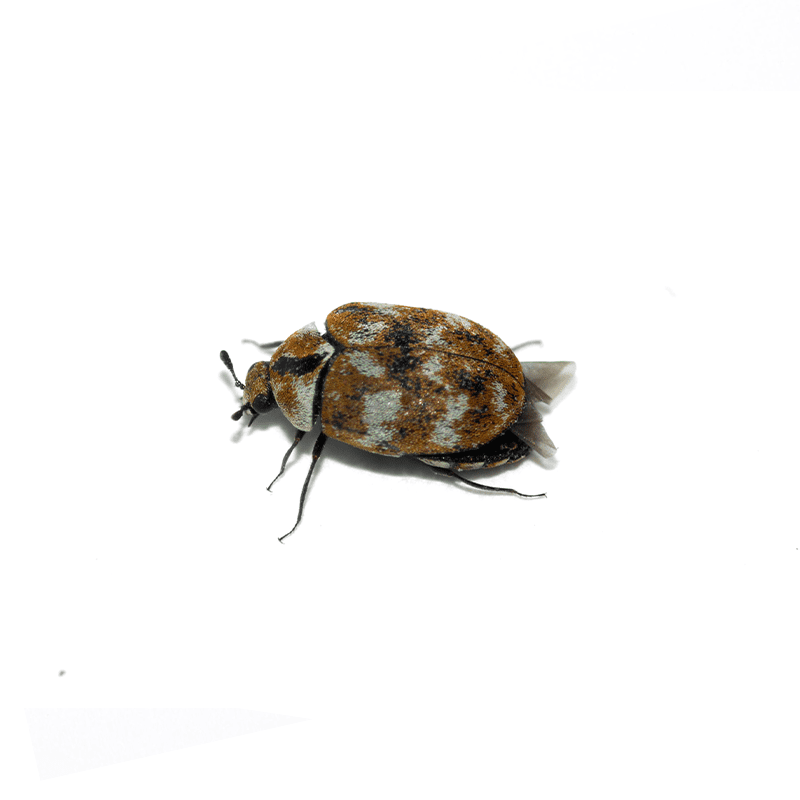
The appearance
- This beetle is about 2-3.5 mm long.
- With yellow, white and black spotted markings
Habits
- It can damage upholstered furniture, carpeting, and some stored food products.
- Not as destructive as black and variegated carpet beetles.
Life Cycle
- Its life cycle is 9-12 months. The dark-colored caterpillar is up to 5 mm long.
- When fully fed they are wide in front but narrow towards the back.
Cigarette Beetles
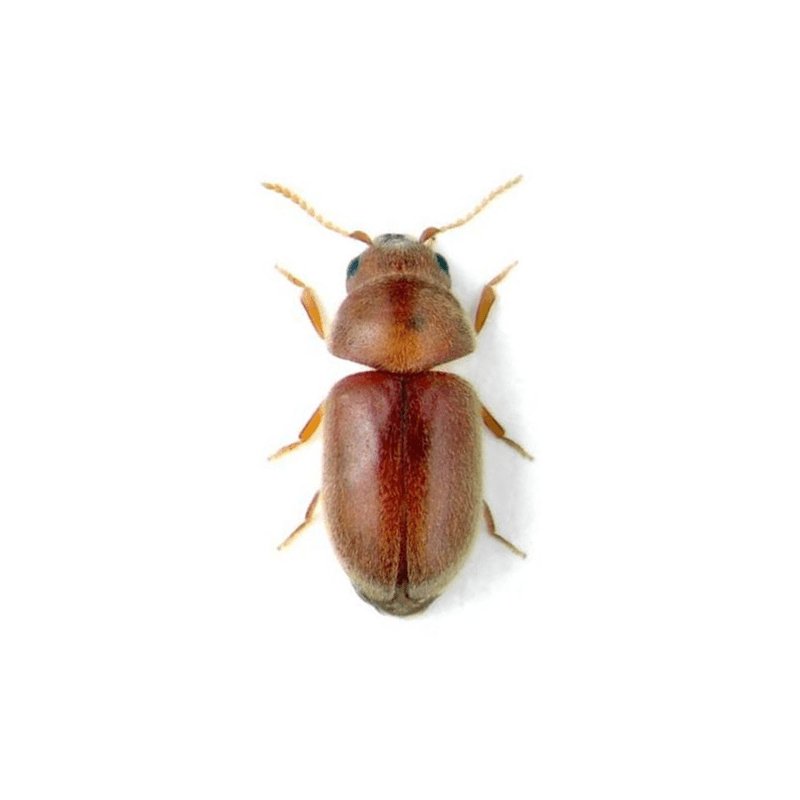
The appearance
- The Cigarette Beetle is about 2-4mm in length.
- The adult is whitish in color, with the head dark brown to tan, and are densely haired.
- The cigarette beetle closely resembles the drugstore beetle.
- The cigarette beetle has the head bent down nearly at right angles to the body giving it a humped back appearance when viewed from the side.
- The larvae are about 4 mm long and somewhat bent.
Habits
- The Cigarette Beetle feeds off tobacco, dry stored food products, spices, seeds, grains and dried plant material.
- They have also been reported in rice, dried potatoes, paprika, raisins, grain-based mouse bait and dried straw flowers.
- Adult beetles often wander away from infested materials and may be found throughout the area.
Life Cycle
- The adult beetles live from 2 to 4 weeks and during this time the females may deposit between 10-100 eggs.
- The eggs are laid loosely on the infested material.
- The larval period usually ranges from four to five months, but under very favorable conditions the development from egg to adult may occur in 6 to 8 weeks.
- When the larvae are fully grown, pupation occurs and they remain in this resting stage for 12 to 18 days.
Grain Beetles
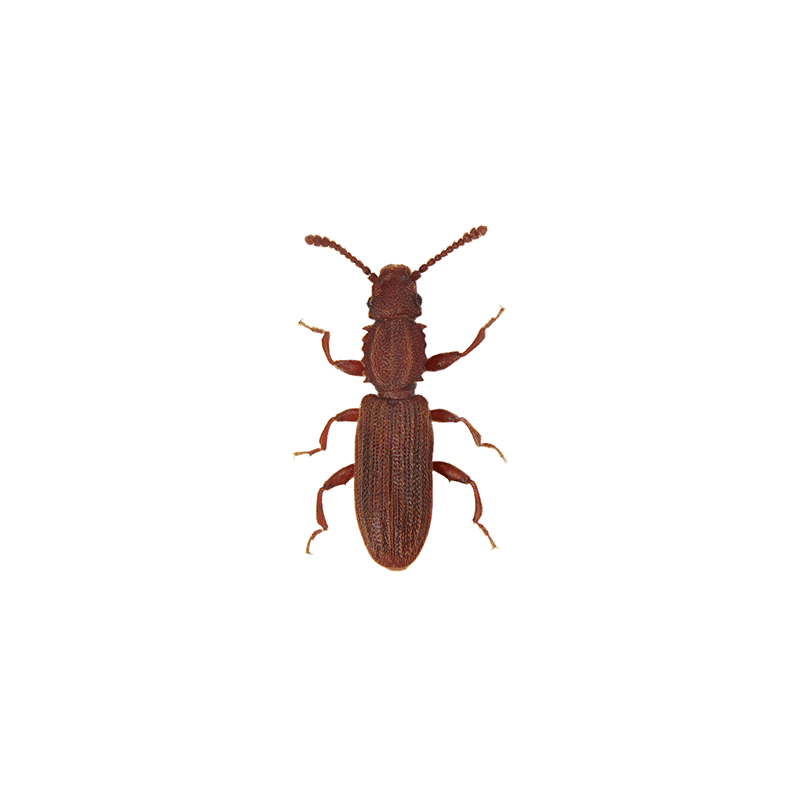
The appearance
- Brown body color. 1/16" to 3/16" in length.
- Antennae have 3 large segments at the end forming visible antenna clubs, reddish in color.
- The humped thorax covers the head, its front rim has teeth–like indentations.
- Elytra (wing covers) are heavily punctated and drop off sharply at the back, giving the impression of a square end when seen from above.
Habits
- Adult beetle is a pest of stored maize, but also infests other types of grain. Larvae bore tubular passages into the grain, typically making one main tunnel with smaller ones branching off.
- Brought in from tropical Central America in cassava roots and tapioca products, as well as in starchy fruits and tubers.
Life Cycle
- The female lays an average of 10 eggs on a grain of maize and the hatched larvae bore into the grain.
- The larva undergoes up to 4 development phases and pupates inside the corn grain.
- Lifecycles can be quite short, in good conditions (25 days at 93°F, 75% relative humidity) there are several generations per year.
Furniture Beetle
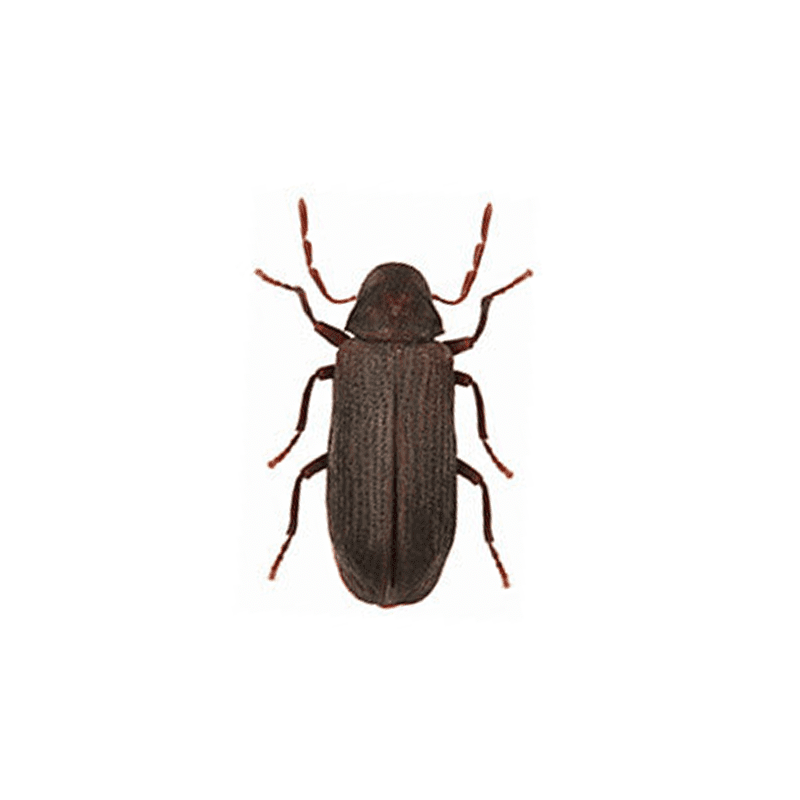
The appearance
- Adult beetle is 3 - 4mm in length.
Habits
- They actively fly in warm sunny weather.
- Within homes and other buildings the furniture beetle is an exceedingly common pest.
- Despite its name this beetle can invade more than just furniture.
- Infestations can damage decorative woodwork, musical instruments, wooden tools and on a more serious scale wood flooring, joinery and structural timbers.
- These wood boring beetles consume hardwoods and softwoods.
Life Cycle
- Larva will live for 3 - 5 years boring through timber before emerging to breed.
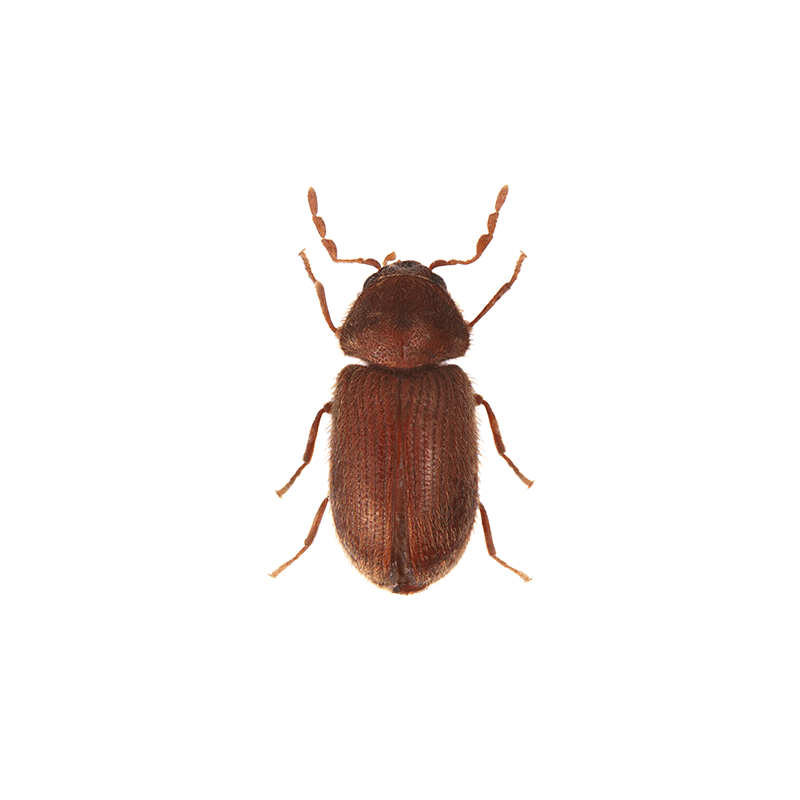
Drugstore Beetles
The appearance
- Approx. 3 - 4 mm long, red-brown, oval beetles.
- The larvae are small and white approximately 0.5 mm long.
- The drugstore beetle is a red-brown oval-shaped beetle.
Habits
- It is not a major pest in stored grains but will attack spices, seeds, grains and dried plant material as well as packaging materials such as paper and cardboard.
- They have also been known to feed on leather, wool, hair and books.
- Their presence can be detected from pinhead holes in the infested items.
- Packaging materials such as paper and cardboard are also attacked.
- Since the drugstore beetle can fly well, the source of infestation can sometimes be hard to find.
- The drugstore beetle is not a major pest in stored grains.
Life Cycle
- The adult beetles live from 2 to 4 weeks and during this time the females may deposit between 20-100 eggs.
- The hatching larvae are 0.5 mm long and very mobile.
- The larval period usually ranges from four to five months, but under favorable conditions the development from egg to adult may occur in 6 to 8 weeks.
- When the larvae are fully grown, pupation occurs and they remain in this resting stage for 12 to 18 days.
Ground Beetles

The appearance
- Many species, very variable in size (1/8" – 1" 3/16" long).
- Colour — black, brown, green or violet (often metallic).
Habits
- Beneficial insects. Predatory and usually nocturnal.
- Do not breed indoors and an invasion of large numbers may be due to disturbance outside of the building.
Life Cycle
- Usually completed in 1 year.
- Larvae are active and voracious predators feeding on caterpillars, slugs, snails and vegetable matter.
Merchant Grain Beetles
The appearance
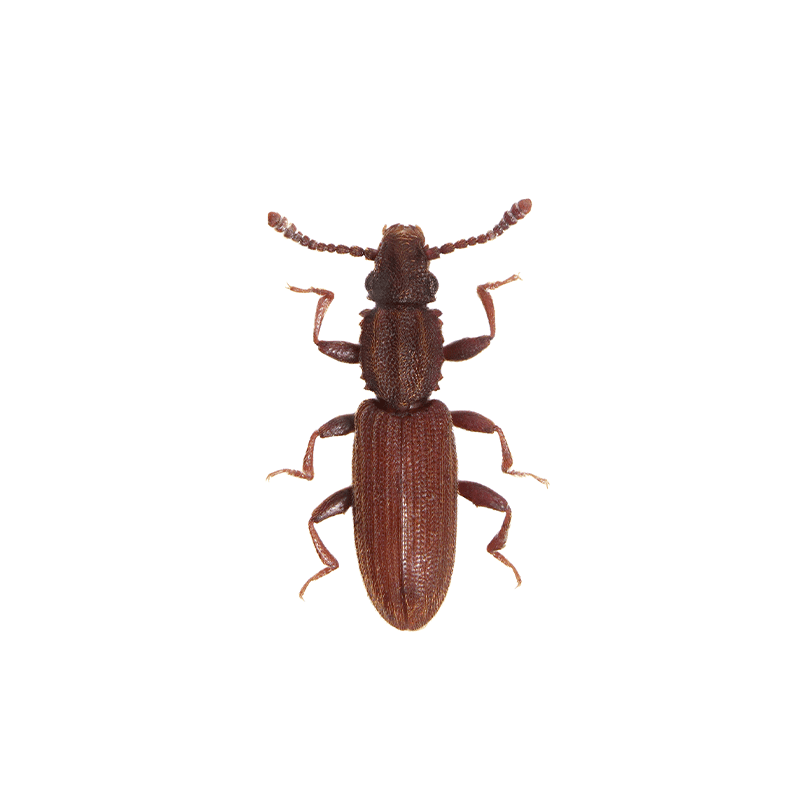
- The adult beetle is dark brown.
- Length is approximately 2.5mm to 3mm.
- It has a slender, flattened body.
- The adult can fly (although it rarely does).
Habits
- The Merchant Grain Beetle is a pest species found feeding in nuts, seeds, biscuits, dried fruit, grain and various other food products.
- The beetles can chew through sealed packaging such as cardboard boxes, plastic bags and foil wrappings.
Life Cycle
- The females lays about 300 eggs in her lifetime.
- Eggs are dropped loosely among grain kernels or tucked into a crevice in a kernel.
- The tiny eggs are slender and white, and hatch in three to five days when environmental conditions are optimal .
- The larvae emerge and crawl freely about the grain to feed on broken kernels. Larger larvae may tunnel into kernels to feed.
- Total development from egg to adult requires about three to four weeks.
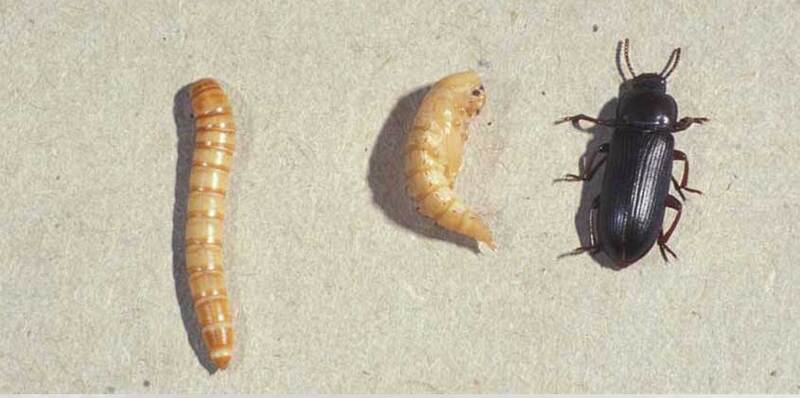
Flour Beetle (Flour worm beetle)
The appearance
Habits
Life Cycle
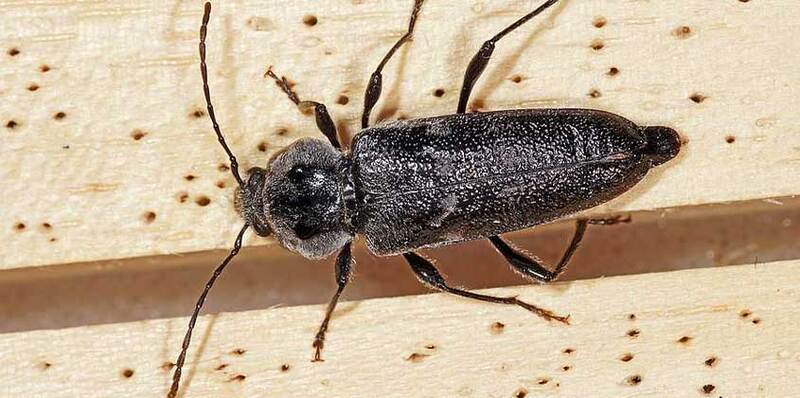
Long-Horned Beetle (Long-Horned Beetle)
The appearance
Habits
Life Cycle
Quick links
Where to Find Us
Our mission is to protect every customer's home with comprehensive, effective pest control and to exceed their expectations at every step. Safeguard is committed to delivering outstanding, high-quality service at competitive prices, because our customers' satisfaction and comfort are our top priority.
All Branches
Riyadh
مكه
المدينه
جده
Riyadh
مكه
المدينه
جده